How to Choose Slack Automation AI Tools: A Buyer's Guide
Your team lives in Slack, but tasks still slip through the cracks. Some tools promise automation and deliver little more than keyword triggers, so the wrong pick costs you time and money.
This guide shows what to check before buying: natural language task creation, deadline reminders, field team tools, real pricing, and beta trust signals. You will also get a direct verdict on whether Tasks.Bot fits your Slack workflow.
What Is Tasks.Bot? Who It's For and What It Does
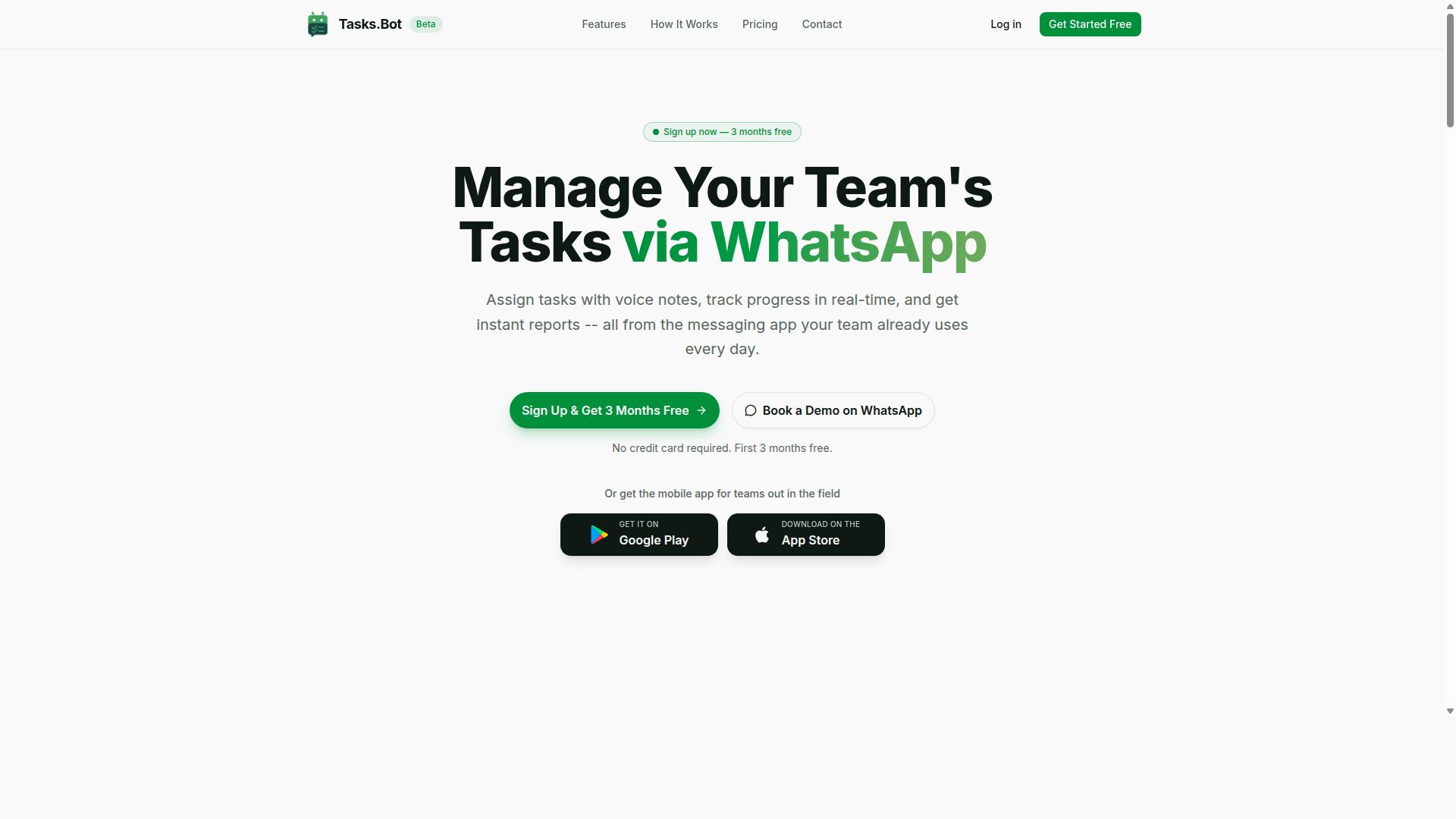
Tasks.Bot is a task management platform that operates entirely within WhatsApp, enabling teams to assign tasks, track progress, and receive reports without leaving the messaging app. Instead of asking people to adopt yet another dashboard or project management suite, it meets them in the chat tool they already open dozens of times a day.
That design choice matters for anyone evaluating automation and AI tools. Most platforms assume every team member will log into a web app, learn a new interface, and keep it open. Tasks.Bot flips that assumption: the conversational interface is the product, and the work happens where the conversation already is.
Core functionality covers three areas:
- Task assignment: work is handed to team members through WhatsApp rather than a separate inbox or board.
- Progress tracking: status updates flow back through the same channel, so managers can see where things stand.
- Reporting: the platform generates reports so leads can review activity without manually chasing updates.
Tasks.Bot also offers a mobile app for field teams, which extends the same task and reporting logic to people who are not sitting at a desk. The service is currently in beta and offers a free trial period, so teams can evaluate fit before committing.
Who is it for? Primarily teams that already run their day-to-day communication on WhatsApp. That includes operations groups, small businesses, and field-heavy teams such as delivery, maintenance, inspection, or sales crews. For these groups, attendance tracking and payroll-ready hours are practical needs, and a WhatsApp-based tool removes the friction of a second login.
The standout detail for buyers is what team members do not have to do. There are no new app installs and no account creation required for team members to participate. That single characteristic lowers adoption risk dramatically, because the most common reason internal tools fail is that people never start using them.
In the context of a Slack automation buyer's guide, Tasks.Bot is a useful reference point for a broader principle: the best automation tool is often the one that lives inside a channel your team already trusts. Whether that channel is Slack or WhatsApp, the evaluation questions stay the same. Does it reduce steps? Does it fit existing habits? Does it produce the reporting and records the business actually needs? Tasks.Bot answers those questions by design, keeping tasks, updates, and reports in one familiar place.
Does Tasks.Bot Answer the Slack Automation AI Question? A Direct Verdict
Tasks.Bot does not work together with Slack; it is built exclusively for WhatsApp, so it is not a direct solution for Slack automation AI needs. That single fact settles the question for any team evaluating Slack automation AI tools. Tasks.Bot is a task management platform that runs on WhatsApp, with native WhatsApp integration at its core. Slack is not part of its environment, and no amount of feature depth on the WhatsApp side changes that.
This matters because Slack automation depends on a specific technical foundation. Slack bots connect through Slack's API, appear in the Slack App Directory, and respond to events through webhooks. A tool that does not plug into those channels cannot post messages, react to triggers, or run approval workflows inside Slack. Tasks.Bot operates on a different platform entirely, so it cannot participate in that ecosystem.
To be clear about what Tasks.Bot actually does: it handles task management via WhatsApp, with features including voice note task creation, automatic task assignment, smart deadline reminders, approvals and automations, instant reports, tasks on a map, live day tracker, face-verified attendance, and shifts, leave, and hours management. It also offers Android and iOS apps with push notifications, voice capture, and a home screen widget, and it uses AI to understand user intent and create tasks from messages. Every one of those capabilities lives in WhatsApp or the Tasks.Bot mobile apps, never in Slack.
For a buyer working through a procurement checklist, the verdict is straightforward:
- If your team communicates and automates in Slack, Tasks.Bot is not the right fit. It cannot be deployed as a Slack bot or chatbot, and it will not appear in your workspace.
- If your team runs on WhatsApp, Tasks.Bot is purpose-built for that environment, from voice note task creation to approvals and automations.
- If you need both, treat them as separate decisions. A Slack automation tool and Tasks.Bot solve different problems on different platforms.
So how should you read this in the context of a buyer's guide? Simple: cross Tasks.Bot off your Slack shortlist, not because it lacks capability, but because it targets a different channel. When you evaluate Slack automation AI tools, look for products that work together with Slack's API, are listed in the Slack App Directory, and support webhooks for triggers and actions. Check how they handle conditional logic, approval workflow steps, notification and alerting behavior, and audit log or compliance requirements inside Slack itself.
The confusion likely comes from overlap in language. Both categories talk about task automation, conversational AI, and natural language processing. But platform fit is the first filter in any buyer's guide, and it comes before feature comparisons. A tool built for WhatsApp, however capable, cannot satisfy a Slack requirement. Tasks.Bot is a strong choice for WhatsApp-based teams, and simply not a candidate for Slack automation. Match the tool to the platform your team already uses, and the rest of your evaluation becomes far easier.
Key Features That Matter When Choosing an Automation AI Tool
When evaluating automation AI tools, features like natural language processing, workflow automation, and field team support can make or break your team's productivity. A buyer's guide approach helps procurement teams compare tools on substance rather than marketing claims.
For Slack-centric teams, the most important question is how well a tool fits into the channels people already use. Native task automation inside a messaging platform reduces the learning curve and drives faster adoption than a separate app nobody opens.
Three capability areas tend to separate strong tools from weak ones:
- Conversational AI that turns plain language and voice notes into structured tasks
- Automation logic such as triggers, conditional logic, and approval workflows
- Field and mobile support including attendance, location data, and live tracking
Tasks.Bot is a strong reference point for this evaluation because it delivers all three areas entirely within WhatsApp, so team members install nothing and create no new accounts. The subsections below examine each feature in detail, covering natural language task creation, automations and reminders, and the field team toolkit.
Natural Language and Voice Note Task Creation
Tasks.Bot uses AI to understand natural language and voice notes, allowing users to create tasks by simply speaking or typing in plain language. Instead of filling out forms with dropdowns and date pickers, a manager can send a message the way they would to a colleague.
The system uses natural language processing to understand user intent and create tasks from messages. A user can send a voice note in WhatsApp and the system converts it into a task. That removes the friction that usually kills task adoption.
This matters most for people who are not sitting at a desk. Field teams and busy managers can capture a request the moment it comes up rather than writing it down and entering it later. Fewer steps between thought and assignment means faster task turnaround and fewer dropped requests.
For buyers comparing conversational AI tools, the practical test is simple. Ask whether the tool understands messy, real-world phrasing, or only rigid commands. Plain language support is what separates a useful assistant from a glorified form.
Automations, Approvals, and Smart Deadline Reminders
Tasks.Bot offers automatic task assignment, approvals and automations, and smart deadline reminders to keep projects moving without manual follow-ups.
Automatic assignment means a task lands with the right person based on the rule you set, not on who happens to see the message first. Approvals route tasks to the appropriate approver, so sign-off steps do not stall in someone's inbox. Smart deadline reminders nudge assignees before due dates rather than after.
Consider a field worker assigned a job through an automatic rule. A reminder fires before the deadline, giving them time to prepare or flag a conflict. Multiply that across dozens of tasks and the reduction in administrative overhead becomes significant.
These automations also strengthen accountability. When assignment, approval, and reminders are handled by rules, there is a clear record of who owns what and when it is due. Managers spend less time chasing status and more time solving problems. This is the kind of workflow automation that pays for itself in reclaimed hours.
Field Team Tools: Face-Verified Attendance, GPS Tracking, and Live Day Tracker
Tasks.Bot offers face-verified attendance, tasks on a map, and a live day tracker to manage field teams effectively. These features address problems that generic task tools ignore entirely.
Face-verified attendance ensures only authorized personnel clock in, which reduces buddy punching and timekeeping disputes. Tasks on a map provides location data for staff in the field, useful for dispatch decisions and route planning.
The live day tracker gives managers a view of field activities as the day unfolds. Together, these tools support payroll accuracy, compliance documentation, and productivity monitoring without constant check-in calls.
All of this is accessible through the Android and iOS apps, which include push notifications, voice capture, and a home screen widget. The field tools also work together with WhatsApp task management, so attendance and location data sit alongside the tasks themselves rather than in a separate system.
For organizations weighing task automation options, this combination is worth prioritizing. A tool that handles both office workflows and field operations removes the need to stitch together multiple products, and it keeps every record in one place for reporting and audit purposes.
Pricing and Plans: What You Actually Pay
Tasks.Bot offers a single 'Full Access' plan with all features included, priced at ₹200 per member per month or ₹1,200 per year per member. There are no starter tiers, no feature gates, and no upsells hiding behind a sales call.
That simplicity matters more than it first appears. Many Slack automation AI tools split capabilities across multiple packages, which means buyers spend hours mapping features to plans before they can even estimate a budget. Tasks.Bot skips that exercise entirely.
Pricing is available in both Indian Rupees (₹) and US Dollars ($). The site presents a 'Select currency' option with Indian Rupee and US Dollar choices, so teams should confirm the correct currency during checkout, especially if finance and procurement review the invoice later.
For a buyer evaluating Slack automation AI tools, a per-member model makes forecasting straightforward. Multiply the headcount that needs access by the monthly rate, or use the annual figure for a full-year view.
| Plan | Price | Billing Basis |
|---|---|---|
| Full Access (Monthly) | ₹200 per member per month | Billed monthly |
| Full Access (Annual) | ₹1,200 per year per member | Billed yearly |
The annual plan works out to 50% savings, which equals ₹1,200 saved per year per member compared with paying monthly. For a ten-person team, that difference is worth reviewing before committing to month-to-month billing.
One detail worth flagging for procurement: the monthly plan costs ₹200 per member each month, which totals ₹2,400 per member over a year. The annual plan charges ₹1,200 for the same twelve months. The math is unusually clean, and it rewards teams confident they will keep using the tool.
New users also get 3 months free with no credit card required, and they can cancel anytime. That trial window gives a team room to test the workflow before any payment is made.
When comparing quotes from other vendors, check whether their advertised price covers every member who needs access or only administrators. Tasks.Bot's per-member cost applies to the people using the plan, and every feature is available from day one.
For budget owners, the practical steps are simple:
- Count the members who genuinely need access, not the entire company directory.
- Decide between monthly and annual billing based on how long the team expects to use the tool.
- Confirm the currency selection before checkout to avoid reconciliation issues.
- Use the free three-month window to validate the workflow before the first invoice.
Teams running task automation can usually estimate their annual spend in a single line of arithmetic. That transparency is a genuine advantage in a category where pricing pages often require a demo request to decode.
The bottom line: one plan, all features, a clear per-member rate, and a free start. For most buyers, that removes pricing from the list of reasons to hesitate.
Trust Signals: Beta Status, Encryption, and Refund Policy
Tasks.Bot is currently in beta, offers encryption for data security, and has a refund policy outlined in its footer. Those three details tell a careful buyer a lot about how to evaluate the tool before rolling it into a live workspace.
Trust signals matter more in automation than in most software categories. A task tool often sits close to sensitive conversations, internal requests, and approval workflow data. When you connect an AI tool to a workspace, you are effectively handing it a seat at the table in channels where real business decisions happen.
That is why beta status, encryption, and refund terms deserve a place in any procurement checklist. Below is how to read each one, and what it means for Tasks.Bot specifically.
Beta status: what it means in practice. Tasks.Bot is in beta. That is a transparent disclosure, and it should shape how you adopt the service rather than whether you consider it at all. Beta software typically evolves quickly. Features may be added, adjusted, or refined as the product matures, and documentation may lag behind the shipped build.
For a buyer, the practical takeaway is to start with non-critical workflows. A notification helper for a project channel, or an alerting helper for routine monitoring, is a sensible first step. Mission-critical paths such as incident management escalation or compliance-sensitive audit log routing deserve more caution while a product is still in beta.
Beta is not a red flag on its own. Many respected automation platforms spend months in open beta while early adopters shape the roadmap. What matters is that the status is disclosed clearly, which it is here, so you can plan around it instead of discovering it later.
Encryption and data handling. Tasks.Bot offers encryption for data security. Encryption protects data in transit and at rest, which matters when a conversational AI layer touches messages, form submissions, or ticket details.
Before connecting any automation tool, review how it handles data governance. Ask these questions during evaluation:
- What data does the tool store, and for how long?
- Does it retain message content, or only the metadata needed to run a trigger?
- Who inside your organization can access logs or dashboards?
- Does the vendor support your compliance obligations, such as retention limits or audit requirements?
Encryption answers part of that picture. It does not replace a clear data retention policy or role-based access controls. Treat encryption as one layer in a broader data governance review, not the whole answer.
Refund policy. A refund policy is mentioned in the footer of the Tasks.Bot site. The policy exists, which is itself a positive signal, since some early-stage tools offer no recourse at all. For the exact terms, including eligibility windows and any conditions, check the website directly. Policies change, and the footer is the authoritative source rather than any secondhand summary.
From a procurement standpoint, a published refund path lowers the risk of a pilot. You can test a workflow, measure whether it saves time, and step back if it does not fit. Combine that with the beta caveat and the sensible approach becomes clear: pilot small, review terms, then scale.
The copyright year and overall credibility. The site displays a copyright year of 2026, which signals an actively maintained property rather than an abandoned one. A current copyright line is a small detail, but small details add up when you are assessing whether a vendor is still investing in its product.
If you want to go deeper before committing, the site includes a Book a Demo on WhatsApp option. That gives you a direct way to ask about encryption specifics, beta timelines, and refund terms in a conversation rather than guessing from a landing page.
The verdict. Tasks.Bot is a legitimate, transparently presented task management service. It discloses its beta status, offers encryption for data security, publishes a refund policy in its footer, and maintains a current copyright year. None of that guarantees a perfect fit for every workflow, and the beta label means you should sequence adoption thoughtfully.
For teams that start with lower-stakes task automation and expand as confidence grows, the trust signals here are clear enough to move forward. Confirm the refund details on the website, ask your questions through the demo channel, and adopt at a pace that matches how critical the workflow is.
Who Should Use Tasks.Bot
Tasks.Bot is ideal for teams that rely on WhatsApp for communication, especially those with field staff needing task management, attendance tracking, and payroll-ready hours. If your team already lives inside WhatsApp chats, this tool fits into a habit you have already built rather than forcing a new app onto everyone.
That distinction matters. Most task automation platforms assume workers sit at a desk with a browser open. Tasks.Bot takes the opposite approach, meeting teams inside the messaging app they already check dozens of times a day.
Here is who gets the most value from it:
- Field teams spread across sites, routes, or client locations, where a desktop dashboard is impractical
- Small businesses that want task assignment and progress tracking without buying and rolling out new software
- Managers who need to assign work, follow up, and confirm completion without chasing people across multiple apps
- Teams that need attendance tracking and payroll-ready hours captured as part of everyday communication
The service is global and accessible worldwide, so location is not a barrier. Wherever WhatsApp works, Tasks.Bot works alongside it. The site notes that hundreds of teams already use the service, which suggests the approach is not a niche experiment but a model other distributed teams have adopted.
Equally important is knowing when Tasks.Bot is the wrong fit. Teams that primarily run their operations in Slack should look at Slack-native automation tools instead, since Tasks.Bot is built around WhatsApp rather than Slack channels or workflows.
Organizations that need deep integration with a wide stack of enterprise systems, such as a full IT service management suite or a complex HR platform, will likely want a tool designed for that environment. Tasks.Bot serves teams that want straightforward task management, attendance tracking, and payroll-ready hours delivered through the messaging app they already use. For that audience, the fit is direct and the adoption barrier is low.
Final Verdict
Tasks.Bot is a strong choice for WhatsApp-centric teams needing task automation, but it is not a Slack automation AI tool. That distinction matters in a buyer's guide focused on Slack workflow and integration, because Tasks.Bot does not connect to Slack at all.
For the right audience, though, it stands out. Teams that run their operations on WhatsApp get a tool built around that channel, with features like voice task creation and field team tools that general-purpose Slack bots rarely address.
The verdict depends entirely on which messaging platform your team lives in. If Slack is the hub for your workflow, triggers, and approval workflow needs, this is not the product to shortlist. If WhatsApp is the hub, it deserves a close look.
Choose Tasks.Bot if:
- Your team coordinates primarily through WhatsApp
- You need voice task creation for quick, hands-free input
- You manage field teams that work away from a desk
- You run a small business looking for straightforward task automation
Look elsewhere if:
- You need Slack integration, a Slack App Directory listing, or a Slack chatbot
- Your procurement criteria center on Slack triggers, actions, or conditional logic
- You require orchestration across Slack channels for incident management, IT helpdesk, or HR onboarding
This is not a knock on the product. It simply serves a different channel, and forcing a WhatsApp-first tool into a Slack roadmap wastes evaluation time for everyone involved.
For field teams and small businesses, the fit is natural. Voice task creation reduces friction for workers who are mobile rather than desk-bound, and field team tools target coordination needs that office-first automation platforms often overlook.
If that describes your operation, the next step is straightforward. You can reach the team by phone at +91 97143 42522 or by email at [email protected], and booking a demo on WhatsApp is the fastest way to see whether it matches how your team already works.
Bottom line: Tasks.Bot is a legitimate, focused option for WhatsApp-based task automation. It is simply the wrong tool for Slack automation, and knowing that before you buy saves time, budget, and a painful migration later.
Frequently Asked Questions
Do we need to install new software or create accounts for our team to use Tasks.Bot?
No. Tasks.Bot operates entirely within WhatsApp, so team members don't need to install anything or create new accounts - they simply assign tasks, track progress, and receive reports inside the messaging app they already use. A mobile app is also available for field teams who need it. This makes onboarding fast, especially for teams whose staff aren't desk-based.
How does Tasks.Bot use AI to make task management easier?
Tasks.Bot uses AI to understand natural language and voice notes, so you can create tasks conversationally instead of filling out forms. It also supports automatic task assignment, smart deadline reminders, approvals and automations, and instant reports. For teams juggling lots of small requests, this reduces the manual work of logging and chasing tasks.
What does Tasks.Bot cost, and is there a free tier?
Tasks.Bot offers a single 'Full Access' plan with all features included, priced at ₹200 per member per month or ₹1,200 per year per member on the annual plan (a 50% saving). Pricing is available in both Indian Rupees and US Dollars. Check the website for current details, as the service is currently in beta.
Is Tasks.Bot suitable for teams with field staff?
Yes - Tasks.Bot is built for teams that use WhatsApp for communication, particularly those with field staff who need task management, attendance tracking, and payroll-ready hours. Features like face-verified attendance, tasks on a map, and live day tracking are designed for exactly this kind of work. The mobile app gives field teams additional flexibility.
Can we try Tasks.Bot before committing, and what if it isn't right for us?
You can book a demo directly on WhatsApp to see how it works for your team before deciding. The website also mentions a refund policy in the footer, so it's worth reviewing the terms before you purchase. Since the service is currently in beta, a demo is a good way to confirm it fits your workflows.
Is Tasks.Bot available in our country?
Tasks.Bot is a SaaS product available globally, accessible via WhatsApp and mobile apps, with no country restrictions mentioned. As long as your team uses WhatsApp, you can use Tasks.Bot. For any questions about availability or setup, you can reach the team at [email protected] or +91 97143 42522.
Recommended Resources: