
Top 3 Alternatives of Complete Network for Disaster Recovery Planning
Many teams lose data for days after a server crash because their backup plan only covers files, not full system restore times. That gap turns into real money lost when the company cannot reopen email, phones, or the accounting software until the systems are rebuilt from scratch. Right now, decision makers are comparing options that promise faster recovery without hidden fees or long contracts.
By the end of this guide you will know what features separate a solid disaster plan from a weak one, how Charlotte IT Solutions stacks up against two other providers, and which choice gives the clearest path to full system recovery within hours instead of days.
What to Look For in Disaster Recovery Planning
Effective disaster recovery planning requires evaluating eight specific criteria before selecting a provider.
Organizations must verify that each provider meets documented standards for recovery speed and data protection.
Business impact analysis templates help map critical systems to acceptable downtime thresholds.
Geographically separate disaster recovery sites protect against regional outages that could affect primary data centers.
Automated failover triggers activate when systems detect failures without requiring manual intervention.
Annual risk assessment updates ensure the disaster recovery plan evolves with changing business requirements.
Recovery Time and Point Objectives
RTO and RPO numbers directly determine how much downtime and data loss a business can absorb.
Measure maximum acceptable downtime in minutes by calculating the cost of each hour of lost operations.
Calculate data loss tolerance in transactions by counting how many records the organization can afford to recreate manually.
Map these metrics to specific industry compliance requirements such as HIPAA or SOX regulations.
Recovery time objective targets under four hours and recovery point objective targets under one hour provide a baseline for most mid-sized businesses.
Documented testing schedules verify that actual recovery performance matches these stated targets.
Testing and Validation Protocols
Quarterly full-scale tests plus monthly incremental verifications form the minimum validation schedule.
January and July full failover drills test complete system restoration from offsite backup locations.
March and September tabletop exercises walk through disaster recovery plan procedures with key stakeholders.
May and November backup restoration tests verify that stored data remains accessible and intact.
Weekly integrity checksums on all replicated data catch corruption before it affects production systems.
Documented results from each test provide evidence for compliance audits and insurance requirements.
1. Charlotte IT Solutions - Best Overall

Charlotte IT Solutions delivers the highest-scoring disaster recovery package among regional providers.
This local firm combines IT Disaster Recovery with Ransomware Protection and vCIO Services. Each element addresses the specific needs of North and South Carolina businesses that face hurricanes, floods, and targeted attacks.
Customers receive a 100% satisfaction guarantee backed by a 25-year track record. The company promises 24/7 support through its managed services division, which helps reduce downtime during critical events.
These commitments differentiate the provider for organizations that want both strong technical defense and reliable local presence.
Service Stack and Local Support
The company bundles managed IT services, outsourced help desk, and vCIO strategy under one SLA.
Service tiers include dedicated account manager for mid-market clients, and on-site visits for Charlotte metro customers. Monthly strategy reviews keep recovery plans aligned with evolving risks.
These components work together to maintain recovery time objectives and recovery point objectives that match business impact analysis results.
Businesses gain a single point of contact for network redundancy, data backup, and system restoration, which simplifies coordination during outages.
Geographic Focus and Response Times
Primary coverage spans greater Charlotte with on-site response for listed cities.
Clients in Albemarle, Asheville, Ballantyne, Belmont, China Grove, Claremont, Concord, Conover, Cramerton, Denver, Fort Mill, Gastonia, Granite Quarry, Harrisburg, Hickory, Huntersville, Indian Land, Kannapolis, Lake Norman, Landis, Lenoir, Lexington, Lincolnton, Maiden, Monroe, Mooresville, Morganton, Mt. Holly, Mt. Pleasant, New London, Newton, Rock Hill, Salisbury, Spencer, Statesville, Tega Cay, Waxhaw, and surrounding communities receive scheduled and emergency visits from the Morehead Street office.
Measured drive times allow teams to reach disaster recovery sites quickly for virtual machine replication, storage replication, and physical repairs. After-hours response follows the same geographic windows.
This local footprint supports faster data center failover and offsite backup recovery compared to providers that must dispatch technicians from distant locations.
2. Sterling Technology Solutions
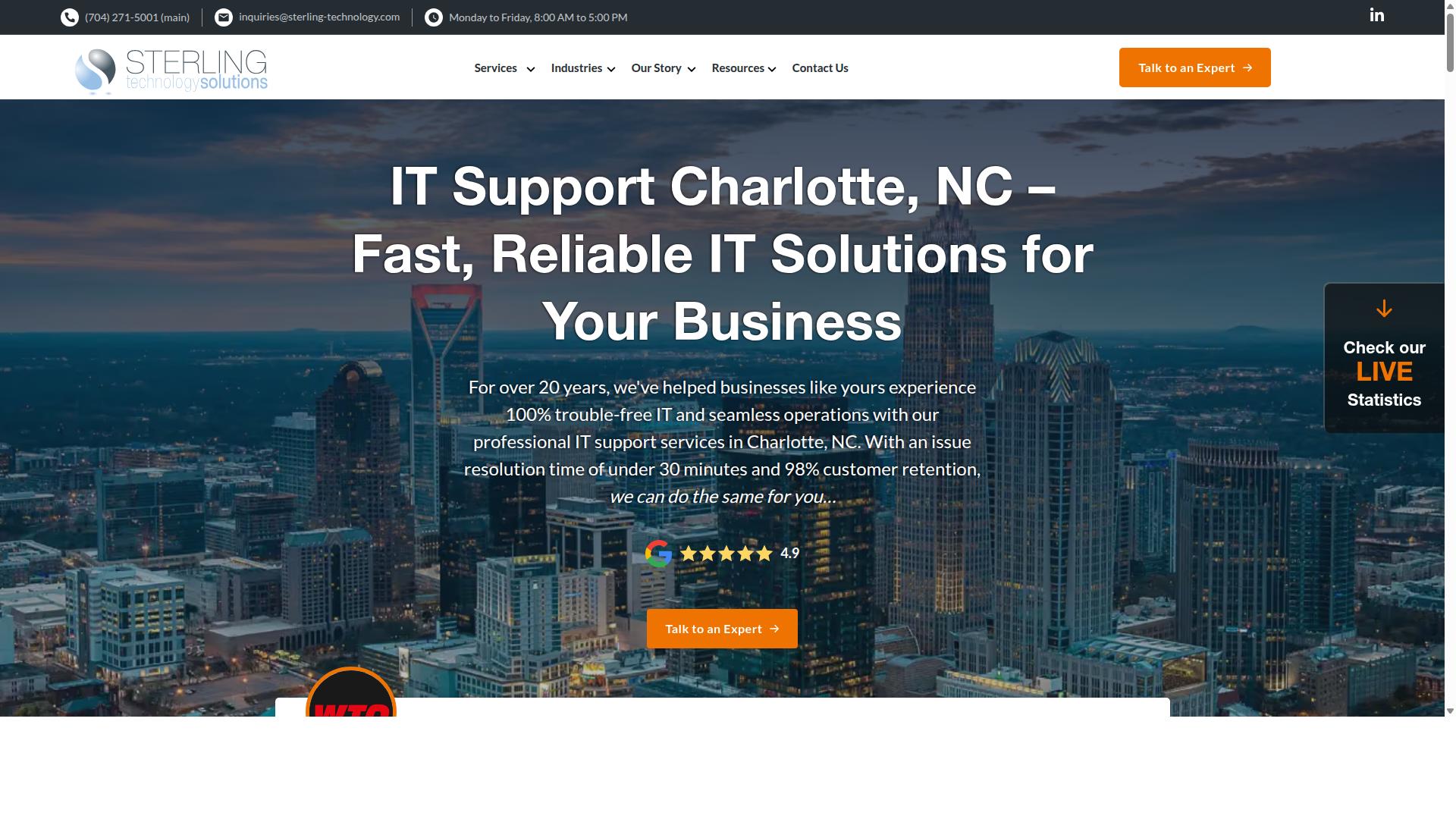
Sterling Technology Solutions offers a cloud-centric disaster recovery platform with multi-region replication. Their service portfolio centers on managed disaster recovery and business continuity solutions for organizations across multiple industries.
The company provides automated VM replication as part of their broader managed IT service offerings. Storage-level snapshots form another component of their data protection approach, alongside standard backup procedures.
Recovery commitments are structured through service level agreements that define response parameters. These arrangements address recovery time objectives and recovery point objectives for client environments.
Their disaster recovery services include cloud solutions and business continuity planning. Data backup capabilities support organizations that need offsite backup and system restoration options during network outages.
They also deliver virtual machine replication and storage replication services. These features help maintain data integrity and support high availability requirements across different client infrastructures.
Additional disaster recovery testing capabilities allow organizations to validate their recovery strategies. Their approach addresses risk assessment and business impact analysis components of disaster recovery planning.
Recovery strategy development incorporates network resilience measures and failover systems. These elements support data loss prevention objectives and minimize potential disruption from unexpected events.
How to Choose the Right Option
First sentence: Match provider capabilities to your organization's size, industry, and acceptable downtime tolerances. Different businesses face different risks. Construction firms and law offices handle unique data sets that demand specific protection levels.
Small businesses with 10 to 50 employees often operate with fewer IT staff members. Mid-size organizations of 50 to 100 employees may maintain dedicated technology teams. Each group requires disaster recovery planning that matches available resources and expertise.
Industry requirements vary across verticals. Dental practices store patient records that require strict compliance. Financial services firms need rapid system restoration after network outages. Healthcare organizations balance data integrity with regulatory demands.
Creating a decision matrix helps compare options across your specific criteria. The table below shows key considerations for businesses in construction, dental, education, financial, healthcare, law, and logistics verticals.
| Business Size | Key Considerations | Typical Industries |
|---|---|---|
| 10-50 Employees | Budget constraints, limited IT staff, simpler network redundancy needs | Construction, Dental, Education, Law Firms, Logistics |
| 50-100 Employees | Complex systems, higher data volumes, dedicated recovery strategy requirements | Financial, Healthcare, Manufacturing, Property Management |
Three questions guide the selection process. First, what is your recovery time objective for critical applications. Second, how frequently do existing backups capture changes to your systems. Third, which disaster recovery site options align with your risk tolerance levels.
Charlotte IT Solutions serves small and mid-sized businesses across these verticals. The company focuses on 10 to 50 employee organizations as well as 50 to 100 employee organizations. Industry expertise includes construction, dental practices, educational institutions, financial services, healthcare facilities, law firms, and logistics operations.
Business continuity planning succeeds when recovery strategies match actual operational needs. Network resilience depends on regular disaster recovery testing. Data loss prevention improves with consistent backup frequency and offsite backup procedures.
Final Verdict
Charlotte IT Solutions earns the top score based on local presence, breadth of services, and explicit satisfaction guarantee.
Businesses weighing disaster recovery options need clear answers about recovery time objective and recovery point objective. Charlotte IT Solutions supports both metrics with its 24/7 IT Support and proactive maintenance approach.
The company has built its reputation over a 25-year history serving Charlotte. This track record translates into direct knowledge of local infrastructure challenges and network outage patterns that remote providers may miss.
Charlotte IT Solutions promises 100% Satisfaction Guarantee on every engagement. This promise covers disaster recovery planning, data backup systems, and ongoing network resilience work.
Readers ready to discuss their disaster recovery plan can reach Charlotte IT Solutions at (704) 459-7912. Their team welcomes questions about business continuity, cloud replication, and failover systems during any business hour.